

Effectiveness of different mouthwash agents and herb extracts in inhibition of Streptococcus mutans biofilm
Abstract
This study aims to examine the efficacy of different mouthwash agents and Traditional Chinese Medicine (TCM) extracts in the removal of Streptococcus mutans ATCC 25175 (S. mutans) biofilm and reducing growth of planktonic cells after rinsing. Crystal violet assay, well diffusion assay and MTT assay were utilised to determine the efficacy of the individual mouthwashes and extracts. The data shows that Cetyl Pyridinium Chloride and water extracted Rhizoma coptidis (Huang Lian) and Fructus armeniaca mume (Wu Mei), had the best holistic performance, with it being the most effective mouthwash in both biofilm removal and in the reduction of planktonic cells. Mouthwash containing ethanol as the active ingredient performed the worst with only a 49.8% decrease in biofilm. Water extracted herbs performance was superior to that of organic solvent extracted herbs. No synergistic effects between the different TCM extracts were found, instead, an antagonistic effect between Huang Lian and Wu Mei was observed. We eventually hope to design and test an alternative natural mouthwash incorporating Huang Lian and/or Wu Mei extracts, identifying the specific active compound found in the respective herbs.
Introduction
Oral health is a key aspect of our lives. Oral diseases affect nearly 3.5 billion people1, and are a pressing issue that must be addressed. With mouth hygiene becoming an ever more major subject, the usage of mouthwash has greatly increased. We hypothesise that a mouthwash containing active compounds found in Traditional Chinese Medicine (TCM) herbs, a TCM mouthwash, is more effective in destroying biofilm than non-alcoholic mouthwash. Biofilm formed by bacteria such as Streptococcus mutans (S. mutans) is the main cause of many oral diseases, including periodontal disease and dental decay. S. mutans adhere to the tooth surface in bacterial communities known as dental plaque, secreting acid and various compounds that elicit inflammatory responses and cause tooth surfaces to be demineralised.
There are various commercially available solutions to combat the rising number of oral health diseases, including the use of mouthwashes. However, data from several studies suggest that all types of ethanol, a prominent ingredient in traditional mouthwashes, contribute to increased oral, pharyngeal and laryngeal cancer risk.2 Ethanol mouthwashes also cause a burning sensation, making it hard for consumers to gargle for the required time, reducing its effectiveness. Therefore, most commercial mouthwashes instead contain Sodium lauryl sulfate (SLS). However, SLS in toothpastes significantly increased the incidence of desquamation (peeling of outer layer of skin) of the oral mucosa.3 Commercial mouthwashes also commonly include essential oils, such as peppermint and spearmint oil which do not have inhibitory effects on S. mutans.4 Additionally, they can cause adverse allergies and other severe reactions.5 Chlorhexidine, one of the most common conventional oral antimicrobial agents, is effective against a broad spectrum of bacteria, yet is artificial and toxic at high concentrations.6 In addition, such antimicrobial agents may not be effective in removing bacteria due to low concentrations in mouthwashes, causing bacteria to develop resistance. With the absence of new antimicrobial agents, there are less options available to remove bacteria as they become resistant to more agents.
An advantage of using TCM rather than artificial oral antimicrobial agents is that some are edible and thus have great potential to be developed as a product for day-to-day use. Not only does the use of TCM open a bank of resources to provide ammunition in the fight against bacteria, but the use of natural products found in TCM may also decrease the opportunity for development of drug resistance in microorganisms as they are surrounded by a group of antimicrobial chemicals acting together. There have been few studies testing TCM on their effectiveness in inhibiting oral biofilms7, making our research significant to future developments of TCM mouthwashes. If TCM is effective in inhibiting and destroying oral biofilm, they might be a better alternative than chemicals to aid in preventing dental diseases
Reviewing past experiments done on antimicrobial activity of TCM against S. mutans, a few TCM herbs were shortlisted based on their effectiveness against the formation of S. mutans biofilm. Cortex phellodendri (Huang Bai), Fructus armeniaca mume (Wu Mei), Rhizoma coptidis (Huang Lian), Fructus crataegi (Shan Zha), Galla Chinensis (Wu Bei Zi) exhibited antibacterial activities against S. mutans with a 8.0 mm, 9.0 mm, 11.4 mm, 5.4 mm, 9.6 mm zone of inhibition respectively7,8.
Materials and Methods
Heat Extraction of TCM Compounds
10% w/v extracts of Huang Bai, Wu Mei, Huang Lian, and Shan Zha were prepared by adding 8 g of each finely ground herb to 80 ml of water and the same method was repeated using an organic solvent, ethanol. The mixtures were heated at 65℃ for 24 hours. Mixtures were then centrifuged and the supernatant decanted into sterile 50ml tubes.
Biofilm Removal Assay
0.5 ml of 108 CFU/ml S. mutans was added to 6 ml LB in sterile 60 mm Petri dishes and incubated at 37℃ for 24 hours with gentle shaking to generate the biofilm. After biofilm was formed, LB was poured away and 5 ml of mouthwash or TCM extract was added to the respective petri dishes and incubated for 1 minute. The mouthwash or TCM extract solution was then poured away. Petri dishes were then dried at 80℃ for 10 minutes to heat-fix residual biofilm before staining with 1 ml of 0.5% v/v crystal violet solution for 10 minutes. The stained biofilms were rinsed gently with water to remove excess crystal violet dye. 6 ml ethanol was then added to solubilise crystal violet dye retained by the biofilm. Concentration of solubilised crystal violet was measured by measuring absorbance at 590nm and normalised against unrinsed control plates.
Percentage decrease in biofilm was determined by where the initial concentration is determined by crystal violet staining the biofilm formed on petri dish after 24 hours of shaking at 37℃.
Percentage decrease in planktonic cells was determined by where the initial OD600nm is determined by measuring the absorbance of LB after 24 hours of shaking at 37℃.
Biofilm Removal Assay with Recovery Time
60 mm Petri dishes with S. mutans biofilm were prepared and incubated for 1 minute with the respective mouthwash and TCM extract solutions as described above. 6 ml LB was then added to the Petri dishes and incubated at 37℃ for 6 hours and 24 hours with gentle shaking to allow for bacterial recovery. Concentration of planktonic cells was quantified by measuring optical density of LB in the Petri dishes at 600 nm. Biofilm formation was quantified using the crystal violet assay.
Well Diffusion Assay
S. mutans was cultured in LB broth and maintained at 108 CFU/ml. 200 μl of culture was spread on 100 mm Petri dishes containing Mueller-Hinton agar. Wells were made by pressing a 9 mm diameter sterile cork borer into the agar. 50 μl of mouthwash or TCM extract were added into respective wells. The plates were incubated at 37℃ for 18 hours. Antimicrobial activity for each solution was quantified by measuring the zone of inhibition (including the wells diameter) which appeared after incubation.
MTT Assay
MTT[3-(4,5-dimethylthiazol-2-yl)-2,5- diphenyltetrazolium bromide] assay would be carried out to assess the metabolic activities of viable biofilm cells. The biofilm was formed as described in the Biofilm Removal Assay and rinsed with mouthwash and plant extracts for 1 minute. After recovery time incubation, LB was removed and gently rinsed with sterile water and replaced with 2ml of MTT (5 mg/ml) for 3 hours in a dark place. Next, MTT was discarded and 2 ml of lysing solution (10% (v/v) sodium dodecyl sulphate and 50% (v/v) dimethylformamide in distilled water) was added to dissolve the biofilm for 3 hours at room temperature before reading the OD590 nm. Plates containing no cells were used as blanks.
Results
| Mouthwash/TCM Sample | Zone of inner diameter / mm |
|---|---|
| Mouthwash 1 | 20 |
| Mouthwash 2 | 26 |
| Mouthwash 3 | 64 |
| Mouthwash 4 | 24 |
| Water-extracted Fructus crataegi (Shan Zha) | 15 |
| Water-extracted Fructus armeniaca mume (Wu Mei) | 15 |
| Organic-solvent-extracted Fructus armeniaca mume (Wu Mei) | 11 |
| Water-extracted Cortex phellodendri (Huang Bai) | 10 |
| Organic-solvent-extracted Cortex phellodendri (Huang Bai) | 11 |
| Water-extracted Galla Chinensis (Wu Bei Zi) | 15 |
| Water-extracted Rhizoma coptidis (Huang Lian) | 20 |
| Organic-solvent-extracted Rhizoma coptidis (Huang Lian) | 21 |
| Chlorhexidine | 23 |
| Controle (Water) | - |
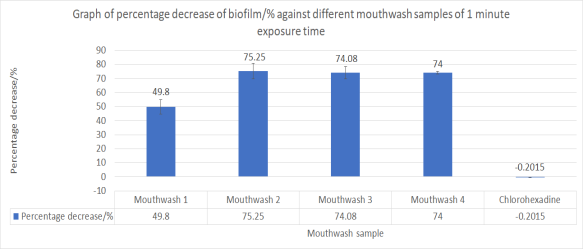
Mouthwash 2 was the most effective in removing biofilm under 1 minute exposure time to mouthwash.
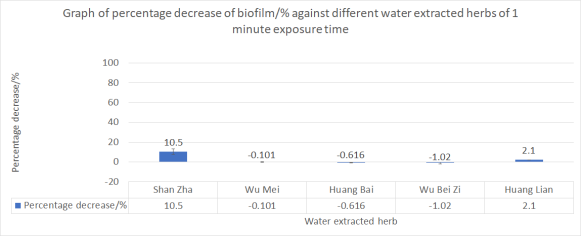
Shan Zha was the most effective in removing biofilm under 1 minute exposure to water extracted herbs.
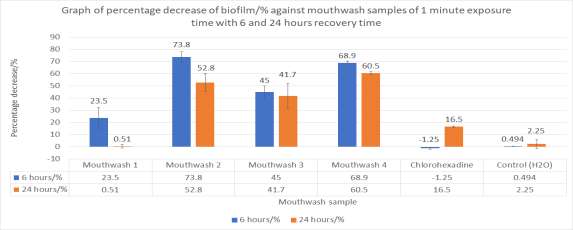
Mouthwash 2 and 4 are the most effective in removing biofilm after 6 and 24 hours respectively.
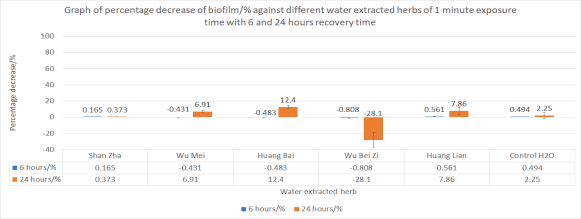
Huang Lian and Huang Bai were the most effective against the removal of biofilm with 6 hours and 24 hours recovery respectively after 1 minute exposure time to water extracted herbs.
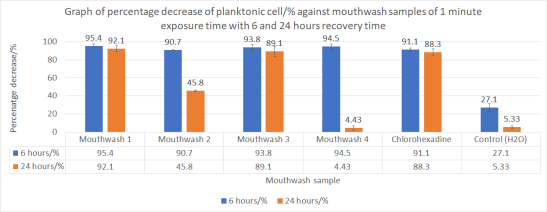
Mouthwash 1 was the most effective in removing planktonic cells for 6 hours and 24 hours recovery time.
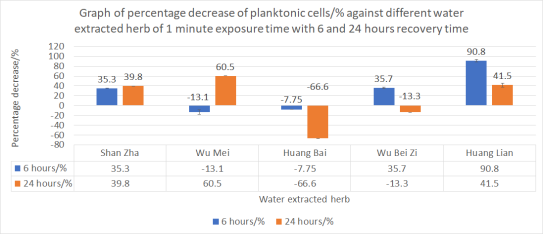
Huang Lian was the most effective in the removal of planktonic cells for 6 hours and 24 hours recovery time with 1 minute exposure time to water extracted herb.
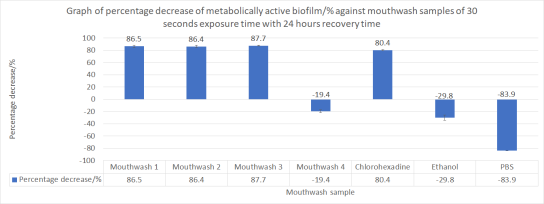
Mouthwash 3 was the most effective in the removal of metabolically active biofilm for both 5 s and 30 s exposure time with 24 hours recovery time.
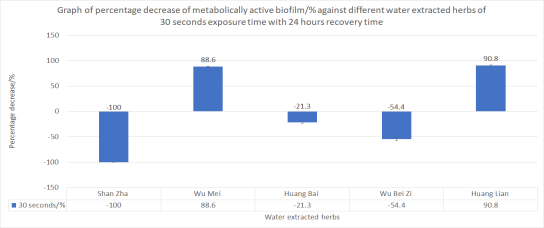
Huang Lian was the most effective against the removal of metabolically active biofilm for 24 hours recovery time with 30 s exposure time to water extracted herbs.
Discussion
In our experiment, we tested our Mouthwash and TCM herb extract samples, with 4 tests, namely, well diffusion assay, Crystal Violet (CV) assay, MTT assay, and Concentration of planktonic cells test. For our preliminary test, we used the well diffusion assay to determine the effectiveness of the sample in inhibiting the growth of S. mutans. After the preliminary tests, we tested the effectiveness of our samples against biofilm removal through the CV assay and the MTT assay. However, the CV essay was not as reliable as the CV dye could be absorbed by both the dead and live S. mutans cells, not allowing us to accurately determine the amount of biofilm removed. Thus, MTT assay was used to most accurately establish which sample was the most effective in removing biofilm. In addition, we utilised the Concentration of Planktonic Cells Test to find out the amount of planktonic cells decreased in each sample to supplement our findings.
After analysing all our results of experiments that were tested with mouthwashes, according to Table 1, our preliminary tests using the well diffusion test showed that Mouthwash 3 had the largest zone of inhibition. Based on CV assay in Figures 1 and 3, Mouthwashes 2, 3, and 4 performed well, they all had similarly high levels of biofilm removal, as well as a low biofilm recovery after 24 hours. The MTT assay in Figure 7, showed that Mouthwash 2 and 3 were the most effective against the removal of metabolically active biofilm. Although chlorhexidine performed well, contrary to our other studies 10, it did not have a greater efficacy than mouthwashes containing Cetyl Pyridinium Chloride (CPC) or essential oils. All 4 mouthwash samples were then tested for the reduction of planktonic cells in Figure 5, in which Mouthwashes 1 and 3 had the highest planktonic cell decrease after 24 hours. In conclusion, Mouthwash 3 had the best holistic performance, with it being the most effective mouthwash in both biofilm removal and in the reduction of planktonic cells. Thus, based on Table 2 CPC is the most effective active ingredient.
Based on our literature review9, we hypothesised that ethanol based mouthwashes would be more effective in killing planktonic cells and removing biofilm. However based on Figure 1, Mouthwash 1 performed the worst, with a 49.8% decrease in biofilm. This could be due to the reduced ethanol content in commercially available mouthwashes since high concentrations of ethanol have harmful effects. Other reports also supported that the ethanol concentrations in mouthwashes are too low to have a significant effect on the destruction of biofilm.10
According to the article7, heat water extraction was used to extract active compounds found in the TCM herbs. Additionally, since organic solvent extraction had not been performed in other researches, organic solvent extraction was carried out to identify other active compounds that are insoluble in water and soluble in the organic solvent, which would contribute to a different result for water and organic solvent extracted herbs.
In general, water extracted herbs performed relatively better in all the tests than that for organic solvent extracted herbs. After analysing our results of experiments that were conducted on water extracted herbs, according to Table 1, our preliminary tests using the well diffusion test showed that Huang Lian had the largest zone of inhibition out of all the water extracted TCM herbs, indicating that it is the most effective in inhibiting the growth of S. mutans. Testing the water extracted TCM herbs’ effectiveness of removing biofilm, according to the CV assay in Figure 2 and 4, water extracted Shan Zha and Huang Lian were the only herbs that showed a decrease in biofilm, while the other herbs encouraged the growth of biofilm. Shan Zha, Huang Lian, Huang Bai, and Wu Mei, had a decrease in biofilm recovery after 24 hours. However, Wu Bei Zi caused an increase in the biofilm after recovery after 24 hours, concluding that Wu Bei Zi is rather not effective. To further differentiate the effectiveness of the remaining water extracted TCM herbs, we tested them using MTT assay in Figure 8, which showed that Huang Lian and Wu Mei were the most effective against biofilm removal. Additionally, the concentration of planktonic cells test in Figure 6 showed that Huang Lian and Wu Mei had the highest planktonic cell decrease after 24 hours. Since Huang Lian and Wu Mei performed relatively well in all the tests, they are the most effective herbs in terms of both biofilm removal and reduction of planktonic cells.
Based on the graphs above, among the water-based extracts of TCM herbs, Huang Lian and Wu Mei performed the best. Thus, they were tested for synergistic effect using the MTT assay. Figure 9, 75% Huang Lian and 25% Wu Mei at 60 s exposure was the most effective. However, when combined together at different concentrations, there was an overall increase in metabolically active biofilm, which shows the antagonistic relationship between Huang Lian and Wu Mei, as they performed better without the presence of each other.
The efficacy of the TCM herbs against biofilm removal is proportional to the concentration of the TCM herbs. Out of the diluted herb extracts, Huang Lian and Wu Mei at 75% concentrations are both the most effective on their own. The efficacy of the TCM herbs against biofilm removal is also directly proportional to the duration of exposure. Thus, when tested with 60 s of exposure time, the herbs caused a higher percentage decrease of metabolically active biofilm than that for 30 s of exposure time. Therefore, to achieve maximum efficacy of the TCM herb, the TCM mouthwash should have the highest concentration of the TCM herb possible and users should rinse their mouths with the TCM mouthwash for a longer duration.
The limitations of this experiment was the inability to identify and isolate the specific active compound in the TCM herb, due to the lack of equipment. The ability to identify the specific active compound will allow us to customise specific extraction methods to isolate and extract the most amount of the compounds. In addition, the heat extraction method has a limit to the concentration of herbs that can be extracted. The herbs would have a greater efficacy if another extraction method which has a higher concentration limit was used. Studies have shown that a TCM herb extract with a higher concentration would have been more effective in killing the bacteria. The current concentration of 100mg/ml in this experiment may have been too low and could be increased. Based on another study, a concentration that was 2250% higher than that in our study was used.7 Hence, an extract with a higher concentration is likely to be more effective in killing the bacteria. Lastly, S. mutans may not be sufficient representative of oral biofilm due to the great diversity of the oral microbe community and the variation of oral bacteria among different persons.
Conclusion
Mouthwash 3, with Cetyl Pyridinium Chloride as its active ingredient, had the best overall performance in terms of biofilm removal and reduction of planktonic cells. Water extracted Huang Lian and Wu Mei were the most effective herbs in inhibiting the growth of S. mutans biofilm and planktonic cells. However, when Huang Lian and Wu Mei were used together, there was an antagonistic relationship. Overall, the active ingredient in non-alcoholic mouthwashes is more effective in inhibiting the growth of S. mutans biofilm as compared to the active compounds found in TCM herbs.
Future work includes investigating the active ingredient in the herb extracts of Huang Lian such that the active ingredient can be extracted. A prototype of a mouthwash using Huang Lian and Wu Mei’s active ingredient and Cetyl Pyridinium Chloride (CPC) can be created. Further investigations on the synergistic effect between the specific active ingredients of herb extracts and mouthwashes.
Acknowledgements and Declarations
The authors declare no conflicts of interests.
Additional Information
| Mouthwash | Ingredients |
|---|---|
| 1 | Ethanol, Sorbitol, Poloxamer 407, Benzoic acid, Flavor, Eucalyptol, Zinc Chloride, Sodium Saccharin, Isopropyl methylphenol (IPMP), Methyl Salicylate, Menthol, Sodium Fluoride, Sodium Benzoate, Sucralose |
| 2 | Sorbitol, Propylene Glycol, Poloxamer 407, Sodium Lauryl Sulfate, Eucalyptol, Benzoic Acid, Sodium Benzoate, Methyl Salicylate, Thymol, Sodium Saccharin, Menthol |
| 3 | Glycerin, Propylene Glycol, Sorbitol, Poloxamer 407, Flavor, Cetyl Pyridinium Chloride (CPC), Potassium Sorbate, Sodium Fluoride, Sodium Saccharine, Menthol |
| 4 | Sorbitol, PEG-8, Xylitol, PEG-60 Hydrogenated Castor Oil, Sodium Benzoate, Flavor, Sodium Citrate, Sodium Lauryl Sulfate, Isopropyl methylphenol (IPMP), Methylparaben, Sodium Fluoride, Citric Acid, Dipotassium Glycyrrhizate, o-Cymen-5-ol, Sodium Saccharin, Witch Hazel Extract |
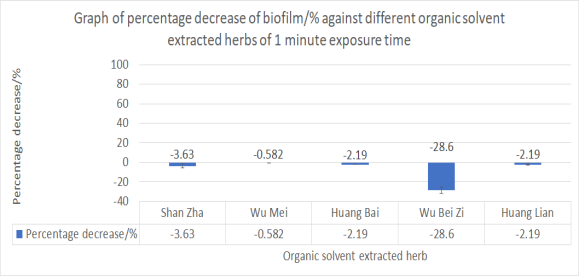
Wu Mei was the most effective against the removal of biofilm under 1 minute exposure time to organic solvent extracted herbs. However, none of the organic solvent extracted herbs were effective against removal of biofilm.
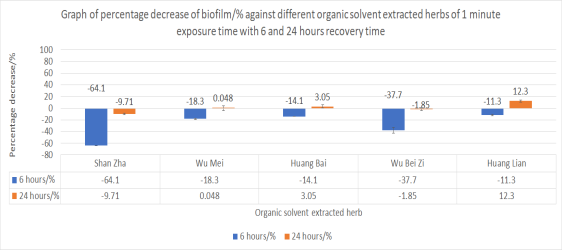
Huang Lian was the most effective against the removal of biofilm with 24 hours recovery time after 1 minute exposure time to organic solvent extracted herbs. None of the organic solvent extracted herbs were effective in removing biofilm after 6 hours recovery time.
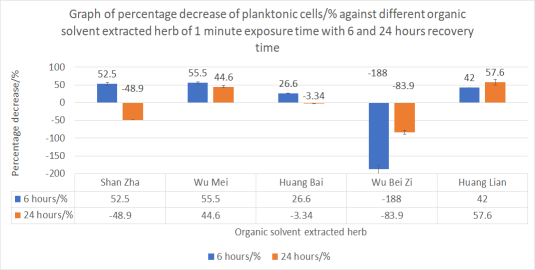
Wu Mei and Huang Lian were the most effective in the removal of planktonic cells for 6 hours and 24 hours recovery time respectively with 1 minute exposure time to organic solvent extracted herbs.
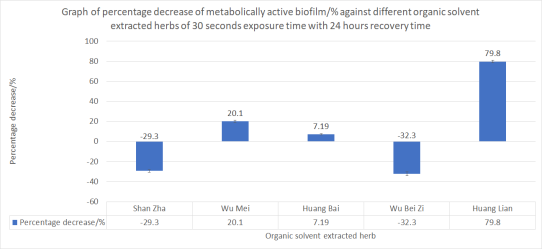
Huang Lian was the most effective against the removal of metabolically active biofilm with 24 hours recovery time for 30s exposure time to organic solvent extracted herbs.